In previous blogs I’ve written about my grandmother’s mother’s side (the nailers) and my grandmother’s father’s side (the miners) and this time we’re staying with my grandmother’s mother’s side but we’re going down a slightly different line…the potters. I hope you’re still with me after that sentence!
So, the father of my great grandmother, Dorothy Amy (from my previous blogs) was James Bradshaw. James was born in 1862 and is most regularly listed in the records as a potter/thrower. Although in his younger years he is listed as a bottle thrower and for a brief period in 1909 he’s listed as a labourer. However, like many men he joined the First World War efforts and he went off with the Royal Hussars. I’m not quite sure how long he spent with them but unfortunately I do know that he died with them in 1916 fighting in Mesopotamia. In general it sounds like the Royal Hussars had a particularly terrible time frequently suffering from starvation, dehydration and sickness (fever, jaundice or dysentery). Understandably morale was also pretty low. On the 5th April 1916 there was an attack on Hanna in Mesopotamia where the starving 14th Hussars surrendered. It was considered one of the low points in British and Indian military history. I’m pretty sure that this is the incident in which my great great grandfather died because his death is recorded as the being the 6th April 1916.
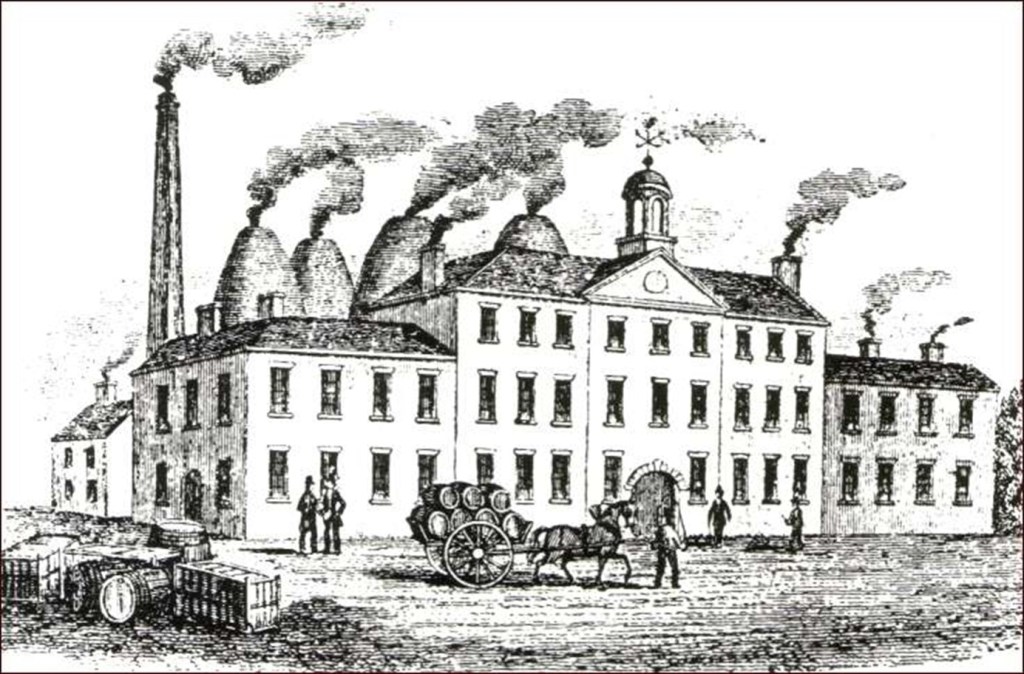
James’s father was John Bradshaw, he was born and died in Belper, and he lived as a potter. John was first listed as working as a ‘potter labourer’ in 1841 at just 14 years old. Conditions were generally rather poor for potters, including (and probably especially for) child labourers. In 1840 many of the workers were under 15 years old and these children spent around 72 hours a week working, meaning that they were poorly educated and exhausted. If they were late to work because they overslept they were often beaten. Its also worth noting that at the time wages were paid in the local pub, meaning that men were encouraged to spend their wages immediately. Their wives often stood outside begging them just to pick up their wages and leave, but instead went home with a drunk husband and little money to get them through the week. Poverty and the desperation to stay out of the workhouse drove potters to keep turning up to work, despite the conditions and long hours of labour. I’ve obviously got no idea if John’s wife, Ellen, was one of the wives waiting outside the pub. What I do know is that at 12 years old she was working with cotton hosiery and then at 22 she was a ‘getter up of hosiery’. I don’t really know what that means! The only thing I can think of was that there was a ‘knocker up’ during the Industrial revolution who woke people up ready for work. Was a ‘getter up’ the same thing? At 23 she got married to John and then was never listed as working again. She outlived her husband though and lived on her own (with her mother who was also widowed) and received relief from the parish, which I don’t imagine was very much.
John’s father James was also listed as a potter throughout his life, and his father Moses was also a potter or ‘bottle turner’ in the Derbyshire area. Their wives are never listed as having jobs and the trail runs cold for additional information beyond birth and death dates from them. I couldn’t find out much about what life was like as a potter in 1780 (not from a google anyway), but I don’t imagine it was any better than in the industrial revolution.
The furthest back I’ve gone on this particular line is 1484, with my 15th Great Grandfather, Roger Fretwell, which is crazy! It’s the furthest back I’ve gone so far. Just to give you a little idea of what the world might have been like, in 1484 Richard the 3rd was on the throne of England (England had not yet united with Scotland, Wales or Ireland (North or South)…although Richard the 3rd did agree a 3 year truce with Scotland this year). This is the one and only Richard the 3rd that died at the Battle of Bosworth effectively ending the Wars of the Roses and the Middle Ages in one foul swoop, the same man who inspired a play by William Shakespeare and the same man whose body was found under a carpark in Leicestershire. In 1484 the Wars of the Roses was still ongoing, but the folk of England only had a few years left to endure of that particular set of battles. They had to endure it alongside other horrors like the sweating sickness though. The sweating sickness was a series of epidemics in the UK and Europe that popped up in rural areas killing folk in a matter of hours after the onset of symptoms. Medical historians still don’t know what caused it but it could have been a rogue hantavirus. Delightful. Outside of the UK the pope deputised a couple of chaps to go and hunt out witches in Germany, a Portuguese chap found the mouth of the Congo (which was very unfortunate for the people residing in that area) and on a lighter note Aesop’s fables were translated into English.
So, all in all, probably a rather challenging time to be alive! I’m not sure what was better, nailer, miner or potter? I’m sure they were all difficult. I’m already intrigued what I’ll find next, and although it’s a goal of mine to ‘finish’ my grandmothers line this year I’m looking forward to finding out if my grandad came from a similar group of people.
It’s time for the second instalment of the family tree! Last time I wrote about my grandmother’s mother’s side, so all the folk that led to my great grandmother, Dorothy Amy. This this time I’ll write about my grandmother’s father’s side stemming from my great grandfather, Bill Wood. I hope that’s not too confusing and, as before, I hope it’s broad enough that you’ll find nuggets of interest even if you’re not directly related to me!
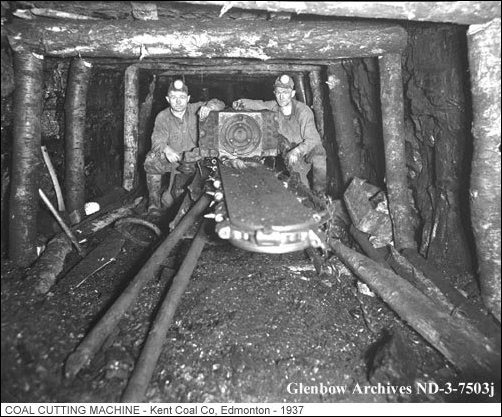
Dorothy Amy’s ancestors were largely nailers (people who made nails), and even though I haven’t quite managed to finish this line yet, I can tell you now that my great grandfather’s ancestors were overwhelmingly coal miners. My great grandad Bill was the most recent coal miner on my family tree and it makes sense to start with him. William Henry Wood was born in Belper in 1908 and is frustratingly difficult to find records for! But what I can tell you is that he is listed as being a ‘colliery coal cutting operator below’ in the 1939 census. Let’s unpack that for a second. So, a colliery is a coal mine, which means a collier is a coal miner, and in lots of the census records I read they specify whether the miner worked above ground or below by just writing the job and then adding the caveat ‘above’ or ‘below’. Having not worked in a coal mine myself and being unfamiliar with the workings, I googled for images of coal cutting machines around the 1940s and the results are pretty much as bleak as I imagined (see image below)! I couldn’t find any more official records of his mining activities, but my grandad remembers him working with the classic mining tools of pickaxe and shovel and that he came home covered in coal dust from his job at the Denby colliery in Derbyshire. My mum has fond memories of him telling her as a child that he’d been mining below the house that day (her parents and grandparents lived next door to one another). I mean, that obviously wasn’t true, but it’s really very sweet!
Great grandad Bill was following in his father’s dusty footsteps. William Wood (my great great grandfather) was born in 1879 and died in 1915 at the age of just 36. In that time, he was listed as working as a ‘colliery engine fireman above’ in 1905, a ‘collier fireman’ in 1908 and finally a ‘boiler fireman’ in the electric works in 1911 for the Derby Corporation. He died young in a hit and run. According to rumour, and I guess family legend, folk knew who it was but as they were wealthy they got away with. Folk also say that William was robbed as he lay there in the middle of the road but I have no idea if that’s really true. Elizabeth, his wife, lived over 40 years without him! She was never listed as having a job, but that’s the case for most of the women in the tree.
Moving on, William and Elizabeth’s parents are definitely an interesting bunch. William’s mother and father (my great great great grandparents) are John Wood (1851 – 1909) and Emma Wood nee Morris (1853 – 1929). John is, you guessed it, a coal miner! In fact, he started mining at the age of 10 and then continued to work as a miner for at least the next 20 years. Around the time he started working a new mining act came in that actually raised the working age to 12, several years before that you could find children as young as 4 working in the mines. It isn’t clear what John did in the mine but in particularly narrow spaces that could hold pit ponies, small women and children hauled the coal out on their hands and knees whilst harnessed to a cart. As well as being smaller, women and children were often cheaper than ponies. Younger children around this time were often sat at trap doors used to periodically ventilate deep shafts and passageways as it was reportedly so hot in some parts of the mine that folk worked whilst nearly naked. It’s generally reported that these children spent most of their developmental years in darkness.
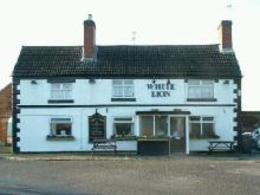
At 40 years old John is mercifully back above ground and actually listed as a beer house keeper and licensed victualler (a person licensed to sell alcohol). I don’t know if he owns the pub or manages it, but he’s listed as being the beer house keeper of ‘The Stanhope Arms’ in Castle Gresley until his death in 1909. A few years after John dies it appears that his wife, Emma, has taken over the alcohol license and she is listed as having an off license. She lives with her sons who are all colliers, one of them is a boiler fireman and another works in motor haulage underground, her daughter doesn’t work. That, to me, seems like a pretty badass thing for a woman to be doing around the turn of the century!
I think this could be ‘The Stanhope Arms’ now the ‘White Lion’.
So that’s the parents of William Wood but what about the parents of Elizabeth Wood nee Wagstaffe (my other great great great grandparents)? Well, Thomas Wagstaffe (1856 – 1916) was a miner (obviously!) and Catherine Wagstaffe nee Oakes (1856 – 1937) was a miner’s wife…like, she was literally listed as ‘miner’s wife in the 1881 census! The interesting thing, for me, about Thomas Wagstaffe is his clear job progression through the census records. In 1861 he is a young scholar, but by 1871 at the age of 14 he is already working in the mine. In 1881 he is still a coal miner but 10 years later in 1891 he is the colliery deputy. By 1901 he is the colliery under-manager and then on a marriage record for one of his children in 1905 he listed as colliery manager. When he dies at around the age of 60 he leaves £916 to his wife, Catherine, and daughter (Elizabeth – who is also a widow by this point). I used an inflation calculator (I have no idea how accurate those things are) and it suggested that £916 is worth about £80,000 now! I’m not sure how much colliery managers earned annually but it sounds pretty good to me! In addition to that, on the ancestry website somebody has uploaded pictures of Thomas and his wife Catherine. I don’t think I have any way of proving that these people in the photos are really Thomas and Catherine Wagstaffe, but they seemed to have enough money to afford nice clothes and get their photographs taken, so I’m happy to go along with it and accept these photos at face value.
Thomas and Catherine Wagstaffe (I think Catherine is the lady on the left).
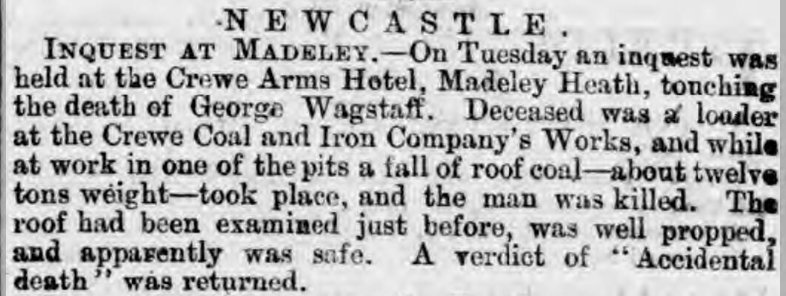
Both Thomas and Catherine’s parents and parent’s parents are, of course, also coal miners…but there are a couple of other interesting nuggets of information here. Thomas’s father, George Wagstaffe, who is my great great great great grandfather not only worked in a mine but perished in one too. Now, coal mines are dangerous places so maybe some of my other ancestors died in mining accidents as well, but for George I have the receipts! Whilst he was working as a loader in one of the pits (coal mines) owned by Crewe Coal and Iron Company he was crushed underneath about 12 tonnes of coal. An inquest was held where they decided it was an accident and that whole incident made the papers. How awful though? It gives me shivers to think of it. …and also, how awful to have been the man that checked the props and declared the tunnel as safe?
The other interesting nugget I found out is that Catherine Wagstaffe nee Oake’s mother, Elizabeth Oakes nee Williams is Welsh. This excites me because finding ancestors that existed outside of the Midlands is like GOLD DUST! It also means that I’m at least 1/64th Welsh and that’s just delightful. I always thought I had a drop of Celtic blood in there somewhere! Elizabeth was born in Llansanffraid Glan Conwy in Caernarfonshire (North Wales) and I have no idea how she made it over the border to marry an Englishman. In 1851 she was working as a servant in Llynsfaern, Caernarfonshire and it’s possible (although the records were sketchy) that her soon to be husband was also working as a servant, but over the border in Cheshire (don’t worry he later became a miner and returned to the midlands!). Did servants have training? Could they both have met there? Did they have family friends that introduced them? I have so many questions about how these folk met…and met for long enough that they decided to marry! Anyway, I know that Elizabeth’s parents were Ellis Williams and Elizabeth Williams nee Roberts and I really wanted to explore my distant Welsh roots, BUT, it was a total minefield. There are multiple couples called Ellis and Elizabeth Williams who have daughters called Elizabeth in that area of Caernarfonshire AND all of the Ellis’s are farmers or agricultural labourers. It’s insane. I eventually want to have another go at unpicking the records, but it’ll be a mission that I come back to another day.
As I mentioned before, there are still a couple of lines I haven’t finished following from this part of the tree, but I always like to make note of the earliest records and have a little investigate of the time period. At the moment, the earliest records from this line are of my 11th great grandparents, John Mather (1634 – ?) and Elizabeth Mather (1636 – 1662) who lived in Staffordshire. This means that they grew up under the rule of Charles 1st and throughout the English Civil war (Staffordshire supported the parliamentary cause…who ultimately won). The war was one of the catalysts or contributing factors for the worst witch hunt in English history. Luckily for John and Elizabeth the puritanical witch hunting craze didn’t reach as far as Staffordshire. I’m actually reading a book about those witch hunts at the moment so it’s on my mind a lot! They then lived through the period in which England had no reigning monarch and the parliament ruled under Oliver and then Richard Cromwell (1653 – 1659). Oliver Cromwell divides opinion. He’s hailed as the father of English democracy and was celebrated as bringing in a new wave of tolerance (tolerance by 17th century standards!), which makes him a fairly popular figure in English history. But, he also invaded Ireland and his name in that regard is linked to words like genocide, massacre and ethnic cleansing. The war he led with his ‘New Model Army’ triggered a famine which was then worsened by bubonic plague. Understandably, in Ireland, Cromwell is not a popular historical figure. After living through such an interesting and tumultuous period in history John and Elizabeth died in more peaceful years under the rule of Charles 2nd. Phew! Anyway, that’s it for this ancestry instalment. On the Worth side I still have my grandad’s mother’s line and my grandad’s father’s line to do and I’m hoping to get these completed this year…so you’ll get two more family Worth blogs whether you want them or not!
Mum and Dad (he’s not a Worth but he’s still quite important!)
Ancestry. This is a bit different from my usual blog posts, but as I don’t know how many people actually read what I write, and as I mostly write for my own pleasure anyway, I thought I’d write about what’s been interesting to me over the past 6 weeks. Although hopefully I can make it interesting to people who don’t share my bloodline too!
I was born in Derby, Derbyshire in 1987 to parents who had been born and raised in Belper, Derbyshire. When I was just 10 days old we moved to Hereford, Herefordshire, which is where I grew up as an only child. Apart from a few stragglers in nearby counties pretty much all of my living family were born, raised and still reside in Derbyshire. We went to visit when I was a kid, I can’t tell you how many times a year but the visits dwindled until, as an adult, I barely go anymore. Because I grew up in Hereford I always felt separate and a bit different to the rest of my family. In fact when we were little my cousin once asked her parents which language I spoke because my accent was so different to hers! My family are lovely, warm and kind but I don’t really know them. It’s always just been me, Mum and Dad; A very small family unit. I don’t have any negative feelings about that, it’s just the way it worked out, but as I’ve gotten older I have started to question my ancestry and who I am a bit more…as in where did I come from.
Anyway, although I was born in Derby and that’s where my close familial roots are, I wouldn’t say that I was from Derbyshire. Although I grew up in Hereford, I don’t feel any ties to the land. I’ve moved around and across the UK several times now and I’ve lived in a couple of different places in both Wales and Scotland. Nationality, ‘home’ and how you identify (as in Northern, Southern, Brummy etc…) comes up when you’re new somewhere because people are interested in where you come from and who you are. I’m English, that’s obvious, I think?! But what does that mean? What kind of English am I?!
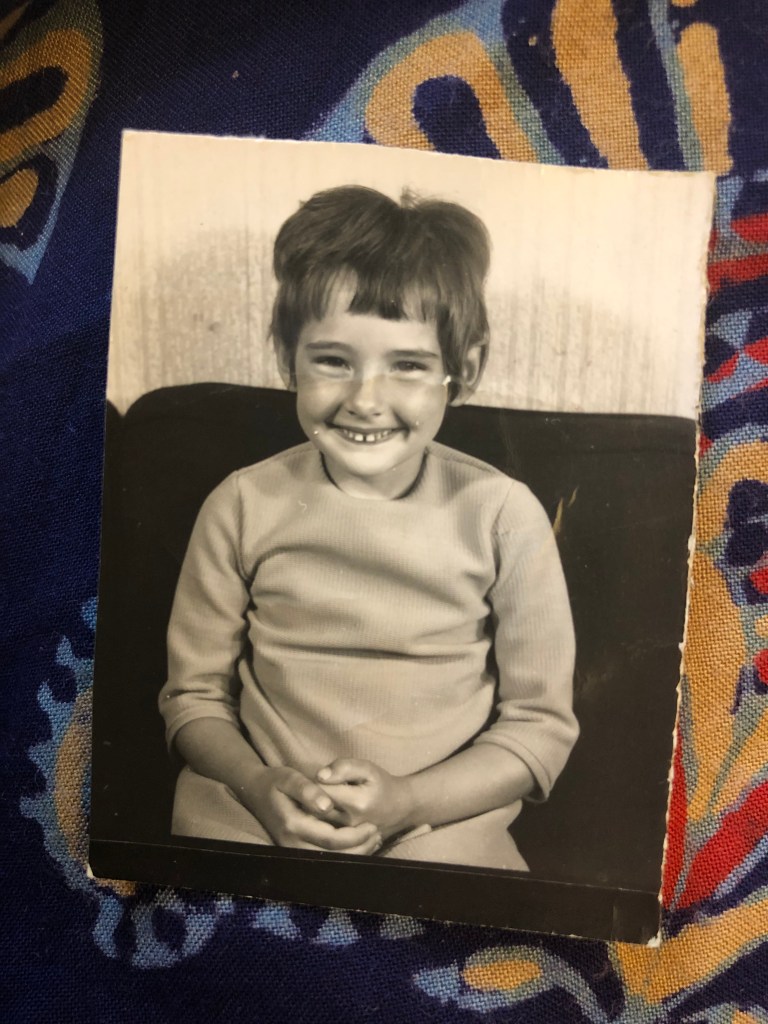
When I went to see my parents recently I got into the old photo collection and started chatting to my Mum about family. In the collection there were some photos she wasn’t quite sure about. For example, Mum knew that a particular picture was my Great-Great-Grandmother but couldn’t tell me her name. So, I started to have a tinker on ancestry.com, and then I got addicted, and then I ended up paying for 6 months membership. I mean doing a PhD is surely the perfect timing to take on a big project like researching your family history!
I’ve been doing this for about a month and a half now and I wanted to share some of the interesting things I’ve found out about my family and the times they lived in. Maybe it’ll inspire you to do some of your own research!
I read that it’s good to pick a side (maternal or paternal) and I decided to start with my maternal side, which is ‘Worth’, for lots of reasons. I’m interested in women’s history, my Grandad Worth has interesting parentage (although that’s his story to tell) and I found an old 1920s Christmas postcard addressed to a woman on this side of the tree called Hilda, and I wanted to know who she was. To begin with I went at the family tree a bit wildly just following lines here and there but I soon got lost! I mean they tell you to pick a side because it’s a big job, but I didn’t quite anticipate how big. So, I decided to go to the furthest right side of my family tree and start following each line down.
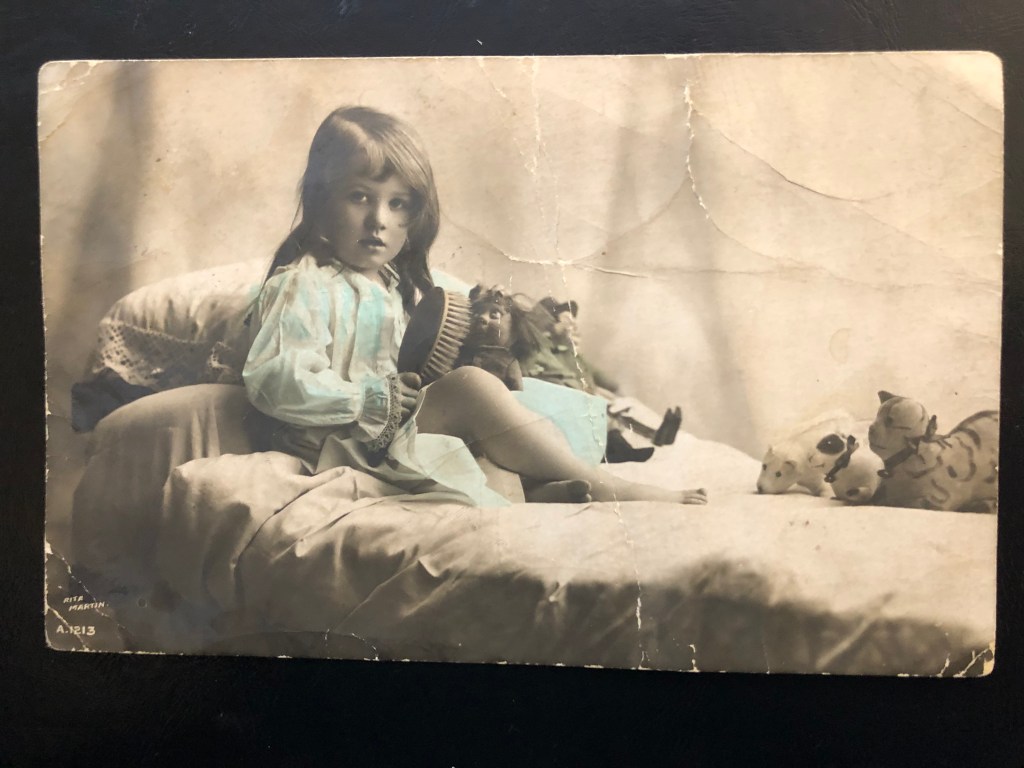
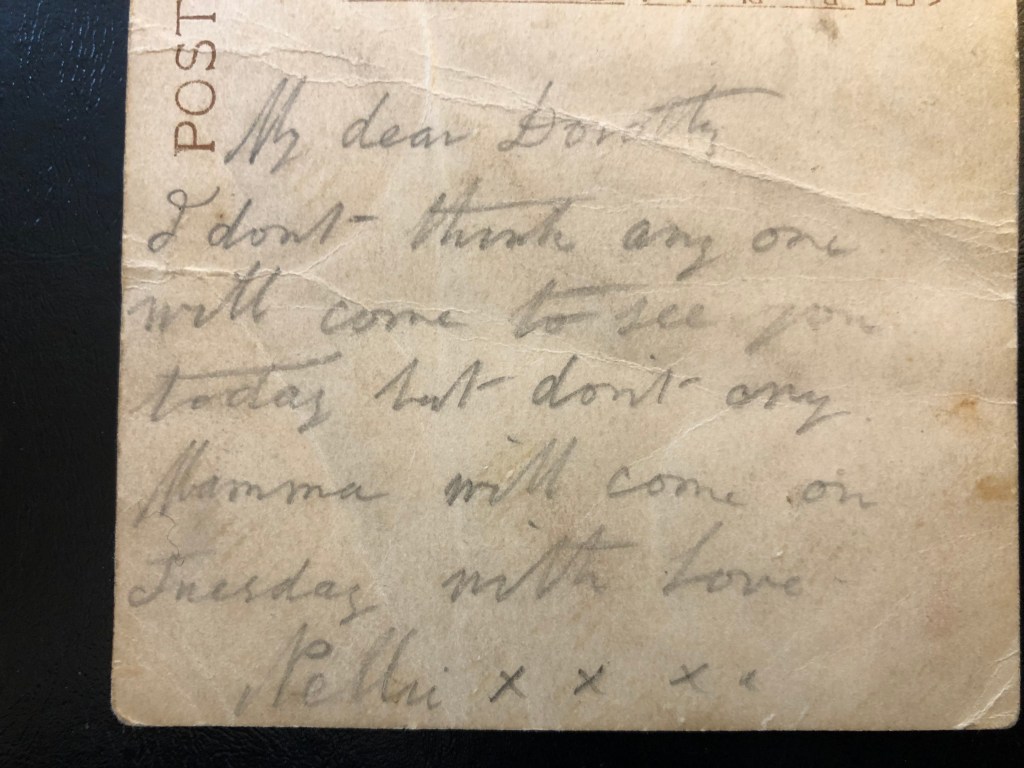
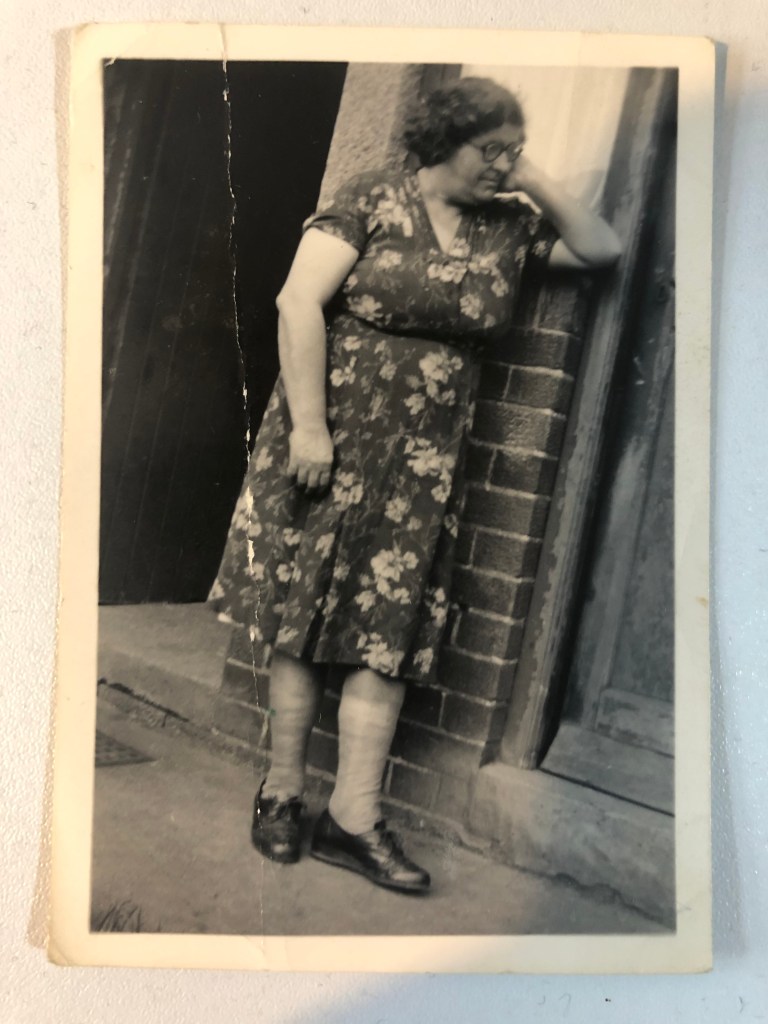
At that side of my tree is my Great-Grandma Dorothy Amy Wood née Bradshaw, my Grandma’s mother. I was actually named after her and my Grandad’s mother, May Worth née Butler. Anyway, so Dorothy was born in 1903 in Belper, Derbyshire. Edward VII was reigning at the time and the Women’s Social and Political Union (WSPU) was formed this year. They fought for the rights of women through arson, throwing stones, smashing windows, shouting at people and going on hunger strikes. Not that Dorothy would have known anything about that in her early years. As a child, Dorothy had Diphtheria, a serious bacterial infection you’re unlikely to come across now due to childhood vaccinations and she went deaf because of her infection. When she was 8 the 1911 census came round and although hers and her mother’s occupations were not listed, her two sisters, Hilde (or Hilda) and Ellen were listed as a ‘mender’ and a ‘lie maker’ (whatever that is) respectively. Her father, James, was a pottery worker. I LOVE the census records. They give the best hints, telling you who people were living with, who’s the head of the house, their ages and what their occupations are. Occupations are more commonly listed for men because…well…the patriarchy, so I get particularly excited about the nuggets of information I find about the women in my family. Much later, at 32 years old, Dorothy married William whose line I haven’t even begun to trace yet and they had several children. In 1939, at 36 years old, she was listed on the census as an unpaid domestic worker and her husband was listed as a colliery coal butting operator. I don’t know exactly what that is yet but I imagine it was hard and dirty work. My Mum remembers him coming home from work and telling the grandkids that he had been mining right below the house. The only other thing I know about my Great-Grandma Dorothy is that apparently, she didn’t like having her photo taken because she had bad legs with awful various veins. These were always wrapped up. She died in 1970 when she was 67.
Before Dorothy things get a little tougher as we’ve moved past living memory and my Mum can no longer feed me little titbits like the Diphtheria fact!
Great-Grandma Dorothy in hospital with Diphtheria and the message her sister Nellie (Nellni) wrote for her on the back of the photo postcard.Great-Grandma Dorothy with her son my Great-Uncle Brian.Great-Grandma Dorothy with her legs bandaged.
Dorothy’s parents were James and Millicent Bradshaw née Webster. Like Dorothy’s husband I haven’t started to trace her father James’s line yet. My Great-Great-Grandma Millicent was born in 1864 in Leicester. At this time Victoria was on the throne, the American civil war was still happening and overarm bowling was legalised in cricket! Millicent’s parents are William Webster and Lydia Webster née Spencer. Millicent’s father, William Webster, whose side I haven’t investigated much was a nailer (nail-maker) for most of his life but was a drummer for the militia in his youth. In the 1871 census, when Millicent was just 7 years old, the family are registered as being in Rotheram, South Yorkshire. I can only see the part of the census document related to her and her sister (Emma, born in Belper) and they are both listed as scholars. I’d love to know what motivated the family to move from Belper to Rotheram through Leicester (where Millicent was born) and then back to Belper again. 10 years later, in Belper, the 1881 census shows that a 17 year old Millicent is working as an embroiderer. Her mother, Lydia, is married to a different man, as in not Millicent’s father. He is called Stephen Walker and he is a deaf, horse nail maker. Nail-making was a common profession at this time and in 1850 the poet, Thomas Crofts, wrote about Belper, “it has nailshops past my counting, where men and women toil, making Roundheads, Forties, Clinkers, for the tillers of the soil”. It’s thought that nail-making was associated with Belper since the Norman Conquest and Belper nails were exported all over the world. The folk (mostly men) who made nails, could famously make 1000 a week. Although, to be fair, if they didn’t make their quotas they would be fined, which I’m sure was a great incentive! Apparently Belper nailers were notorious in their unruliness. Although they were incredibly hard working they were also, in general, hard drinking, rebellious trouble makers. There’s an old anecdote, which I hope is a joke, that goes as follows; “An innocent stranger puts his head inside the window opening of a nailer’s shop and asks “What’s the time?” The nailer pauses from his work, and brings his hammer down hard on the stranger’s head, answering gleefully, “It’s just struck one!”. They did, however, have a reputation for violence so maybe it’s true! Another chap, a reverend, describes Belper as an “insignificant residence of uncivilised nailers” and describes it as the “rudest place”, bar one, that he knew! Charming, huh?! There are actually quite a few nailers in my tree and I love that so much of my ancestry relates to these outspoken folk, it sounds like anarchy!
Anyway, I digress, let’s get back to my Great-Great-Grandma Millicent. At 19, in 1883, she marries James Bradshaw who is listed in the 1891 census as a bottlemaker. Her occupation is not listed here, and her children are scholars or too young to be schooled. At this time her mother, Lydia, is living with her and working as a charwoman, so presumably she’s widowed again. Charwomen worked as domestics, but they didn’t have fixed schedules, working when and where they could. Millicent doesn’t have a listed occupation in 1901 or 1911 but her husband is now a potter. After that I lose Millicent in the censuses, but she dies in 1932 at 68 years old.
It gets harder and harder to trace the interesting details of people’s lives after Millicent and her mother Lydia (my Great-Great-Great Grandmother) and it’s just because as you leave the 1800s and enter the 1700s the censuses are far less available and marriage records stop listing the father’s occupation. In some ways it does become easier to log names and dates though. There’s less information to sift through and I guess fewer people on the planet the further you go back. It also helps massively if another ancestry searcher has already done some of the hard work of sifting through the records for you! Millicent’s ancestors mostly hail from the Midlands; Derbyshire, Staffordshire and Leicestershire. But there is a moment in the mid-1600s where I think that there could be some aristocratic folk that moved to England from Prussia (Germany/Denmark area). The line is really confusing though. Essentially, I think there are 2 men with same name who marry 2 women with same name in the same area and I’m not confident that I’ve picked the right man and woman! I’d love to have some Prussian aristocracy in my bloodline but I think I need to sit down and have another go through all the online records and maybe even physically go to the records office (when I can). So, I’m not confident enough to go through that here, now. Exciting though!
One interesting story I’ve gleaned pre-1800s though, and one I’m far more confident on, is that of my 6th Great-Grandfather John Mayer (that’s Great-Great-Great-Great-Great-Great-Grandfather!). He was born in 1738 in Wolstanton, Staffordshire. At this time George II was on the throne (wearing one of those super poncy wigs) and slavery was very much the ‘in thing’, but they had slowed down on the witch hunting, with some of the major witchcraft acts being repealed 2 years earlier. I would be so interested to find a witch amongst my ancestors…although I could assume if I did nothing good would have happened to her! Anyway, John Mayer. Beyond his birth record the first time I find him he’s 38 and a weaver, and he must be doing okay for himself because he has an apprentice called Samuel Robinson (you had to pay duties for having an apprentice).
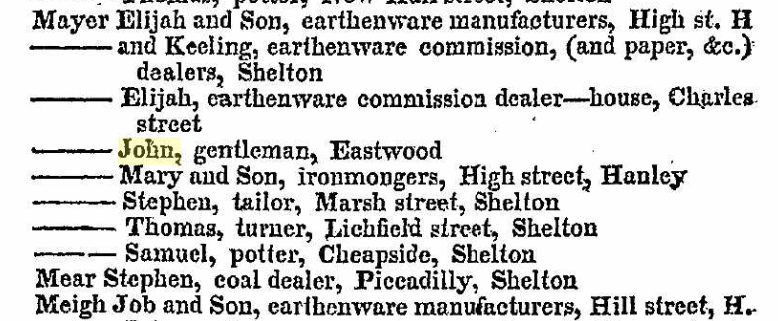
Many years later in 1818 when John Mayer (also spelled Mare…spelling becomes a lot more loose and carefree the further you go back) is 80 years old he is listed as being a gentleman. I’m not totally sure what this means but I think essentially he’s a ‘free-man’ as in he didn’t have or need a job.
Three years later my 6th Great-Grandfather is charged with uttering base coin! Essentially, he was trying to spend adulterated money. He didn’t ‘present’ at the trial and he was acquitted. Maybe they took mercy on him because of his age or status or maybe they thought he was innocent (although they don’t say he wasn’t guilty!). The chap above him in the criminal register committed the same crime and went to prison for 6 months. A few years earlier this crime was considered high treason and if you were caught 3 times you were hung! What a rebel?! He died just a couple of years after this at the lofty age of 85.
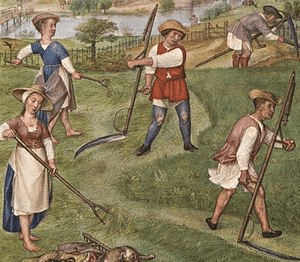
The furthest back I’ve traced in this line (the line of my Great-Grandma Dorothy and Great-Great Grandma Millicent) and earliest records I’ve come across so far are that of my 17th great Grandparents John and Johanna Fardon (Vardon). That’s too many ‘greats’ to type out even to make a point! John was born in 1485 and died just 23 years later and Johanna was born in 1490 and massively outlived him reaching the lofty age of 72 years old. When they were both born in 1485/1490, the Tudor, Henry VII, gained the throne by killing King Richard III at the Battle of Bosworth (the last battle in the Wars of the Roses). He was the last monarch to die in battle and he was the chap whose remains were found under a parking lot in Leicester. Johanna would have been alive to see the reign of Henry VIII and the mess that followed him with the young King Edward VI, Lady Jane Grey, Bloody Mary, Phillip and finally Elizabeth I, who I guess brought some royal stability. At this point the United Kingdom or Great Britain didn’t exist and these guys sat on the English throne (although, by this time the eldest son of the monarch was usually the Prince of Wales…it’s complicated). I can’t tell you much more about John and Johanna other than they were born and died in Broughton, Oxfordshire. The further you go back the simpler and more difficult to read the records get. I rely a lot on what other ancestry searchers have done before me and at some point to find out any more about these people I’d have to go to the place they lived and look at the physical records.
What John and Johanna could have been wearing presuming they were peasants. Picture taken from the Grimani Breviary
Obviously, I was always aware that I had ancestors, I mean, we all are…but having the constantly growing expanse of names make me more distinctly aware of it. Like, I’m actually related to people who were alive during the Norman Invasion, saw the arrival of potatoes and went through plagues (proper plagues with boils and ‘doctors’ wearing bird masks, not COVID19). Okay, they’re very distant relations at that point but I still think it’s cool.
I still have a lot more searching to do but from what I’ve seen so far I think it’s relatively clear that I am absolutely a Midlander! Ultimately it never really mattered to me where my known ancestors came from but I’m glad that I’m starting to find out.











 In A Kingdom By The Sea